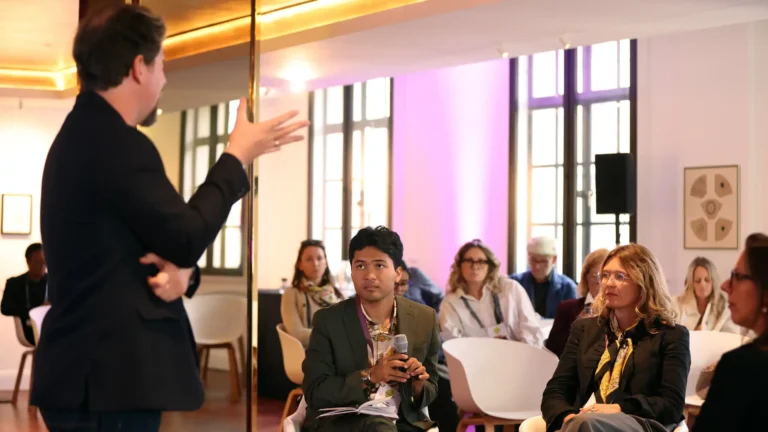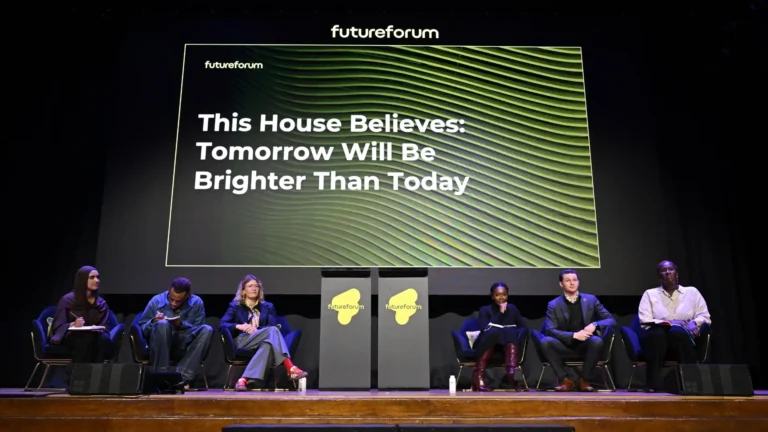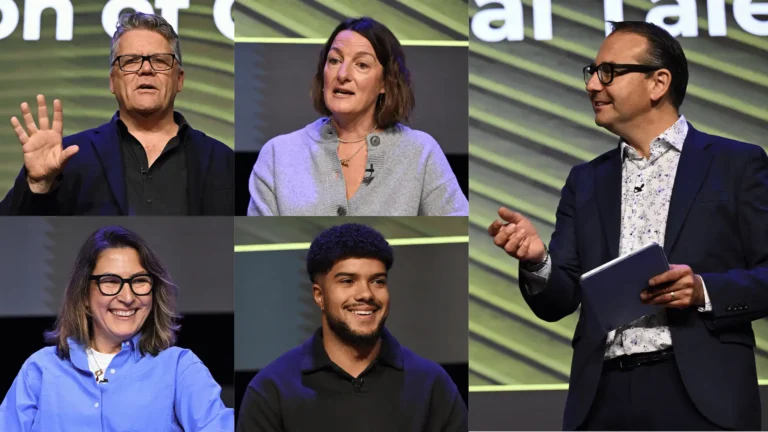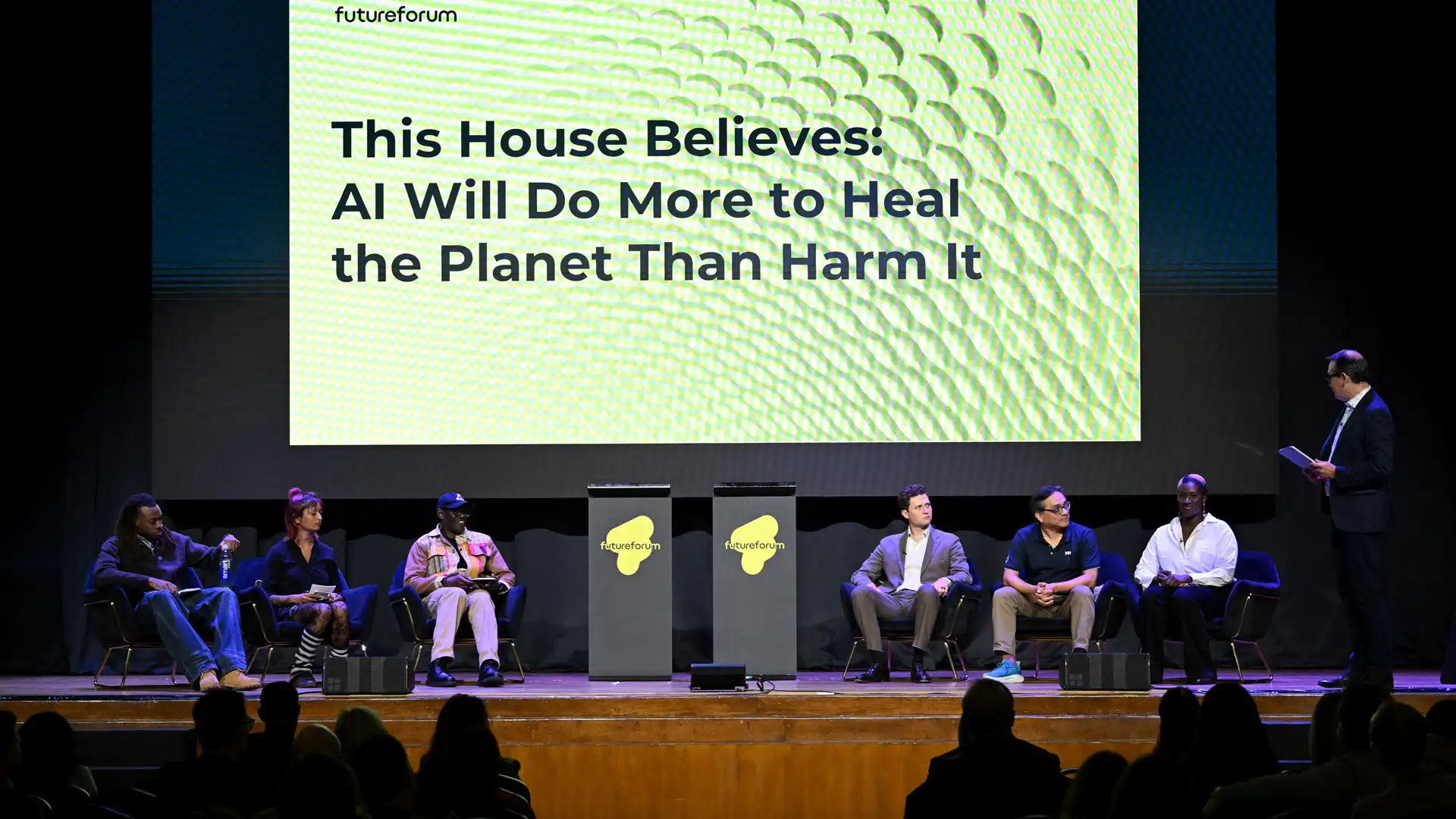
In this Future Forum Debate, six speakers discussed the motion ‘This house believes AI will do more to heal the planet than harm it’ in an Oxford Union-style debate.
Can artificial intelligence do more to heal the planet than harm it? Or are we placing too much faith in a technology whose consequences we’re only beginning to understand?
That was the motion at Future Forum, where six speakers took opposing sides in a debate that moved far beyond AI’s environmental footprint.
Moderated by Oli Barrett MBE, the session brought together voices from technology, business, community leadership and education, with Debate Mate helping to create a space for what Barrett described as learning to “disagree agreeably”.
The question wasn’t simply whether AI could transform our world. It was whether its benefits would ultimately outweigh its costs.
FOR: A new era of possibility
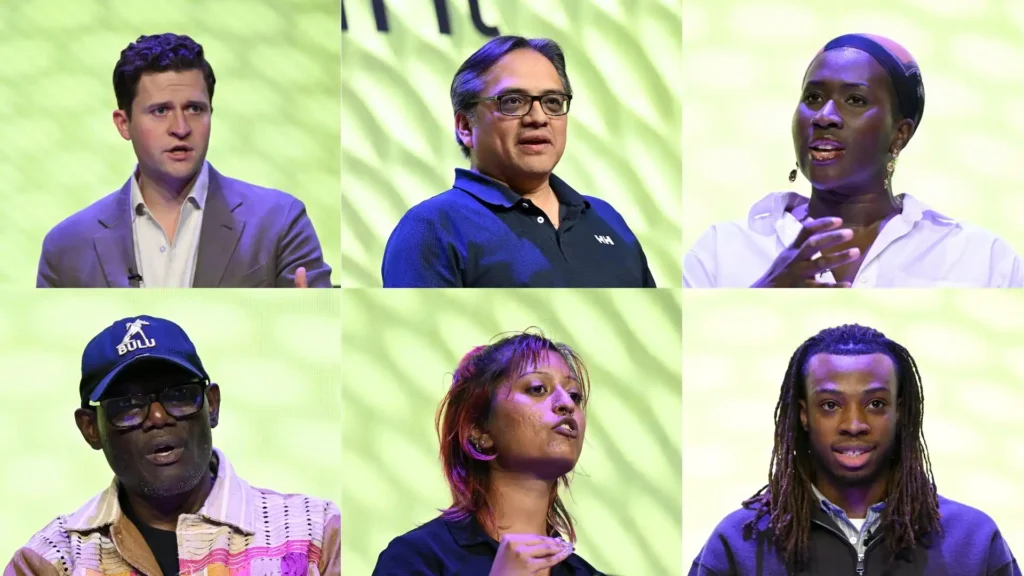
Opening the proposition, Bjorn Hovland, president of CIQ, said there is no such thing as a good or bad technology.
“Technology is a tool, and the question is how society and how individuals and how companies use that tool,” he said, claiming technological advancement had lifted 1.5 billion people out of extreme poverty in the last 35 years.
Although Hovland conceded that he can’t give any guarantees that AI will do more to heal the planet than harm it, he dismissed environmental fears by claiming that the California almond industry “uses more water in a year than every data centre in the world.”
Tim Flagg, CEO and Co-Founder UKAI, talked about the “myths” around the water and energy use of data centres and claimed that British companies building these facilities have become much more efficient in their energy consumption: “The amount of water used by a family of four would power a data centre for 15 years,” he said, arguing against calls for the banning of AI and data centres in the UK.
The third speaker for this motion, Esther Mark, Programme Director Consultant at Debate Mate Online, suggested that AI is not different from revolutionary technologies of the past, such as the discovery of fire or electricity.
“The only thing that separates them is time,” Mark said. “But that time is valuable because it ensures that we can learn from all the previous mistakes that we have made when it comes to technology to ensure that AI will heal the planet more than it will harm it.”
AGAINST: What are we overlooking?
Speaking against the motion, Olu Alake, CEO of the Africa Centre, said that recent research showed that data centres have worsened conditions in 11 countries with the worst water scarcity.
“It’s a function of privilege if you’re not living in those communities to think that it is not doing any harm to them,” Alake said, adding that AI is also “extracting creativity without reward, without justification, without compensation”.
Debate Mate Schools Student Esha Amin warned that AI is replacing human connection, with young people turning to chatbots for therapy. “We’ve forgotten how to communicate. We’ve forgotten how to rely on our community,” they said.
Amin also argued that AI isn’t diverse because it doesn’t encourage critical thinking or diversity of thought, which carries serious risks in a politically polarised world.
“AI tells you exactly what you want to hear,” they said. “It’s a learning model that’s based on making you ask it more questions and rely on it more because you just want to hear the same thing again and again.”
Fellow Debate Mate Student Emmanuel Areoye closed for the opposition, questioning the proposition’s framing, arguing the burden of proof had not been met.
“You don’t look at Anthropic and go, these guys are trying to heal the world,” he said. “You look at them like they’re trying to impress their stockholders, which is fine, it’s a good money move.”
Areoye also argued that not every technological advancement has helped heal the world, citing the atomic bomb and guns as examples.
“If AI is a glorified Google, would we ever say Google was doing more to heal the world than harm it? I don’t know,” he concluded.
Following a straw poll with loud ayes and nays from the floor, the final vote remained divided, with chair Oli Barrett declaring “we’re on the fence of the debate and the conversation continues…”.
Related podcasts
The Man Behind GOV.UK on AI, Digital Transformation & Why Most Organisations Get UX Wrong with Ben Terrett CBE
What makes great digital products? Ben Terrett CBE helped create GOV.UK, one of the world’s most respected digital services, before becoming CEO of Public Digital, where he now advises governments and organisations across the globe on digital transformation. In this episode of Tomorrow, Ben joins Victoria Usher and Oli Barrett…
AI, Growth & Exports: How Britain Can Compete Again with Shevaun Haviland CBE
Is Britain still one of the best places in the world to do business? In this episode of Tomorrow: The Future Forum Podcast, Oli Barrett MBE sits down with Shevaun Haviland CBE, Director General of the British Chambers of Commerce, to explore the biggest opportunities and challenges facing UK businesses.…
Related speakers
-

Bjorn Hovland President of CIQ
A technologist who has built across products, capital and infrastructure.
Bjorn’s profile