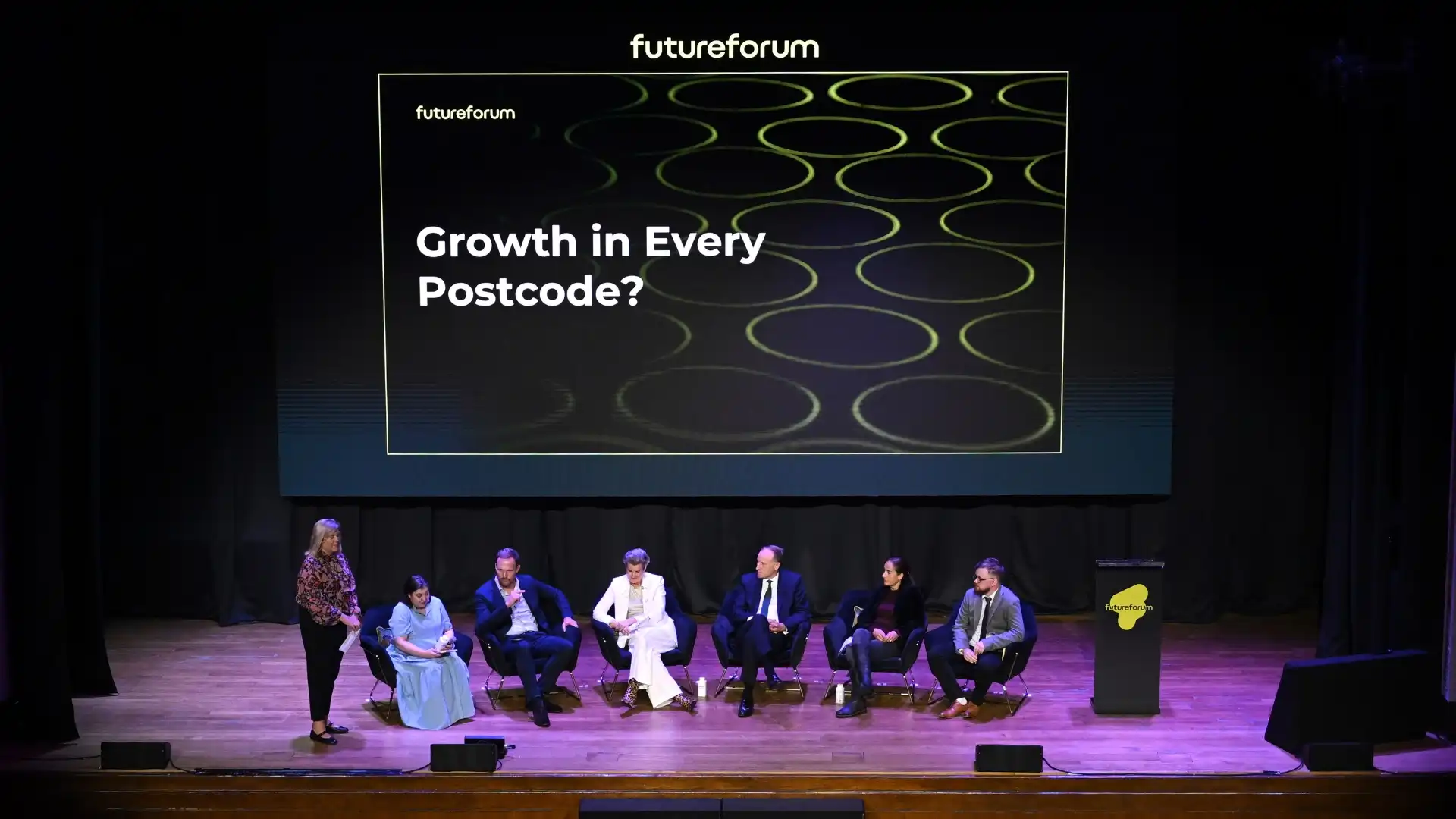
From Manchester’s innovation districts to Scotland’s energy sector and London’s creative clusters, Future Forum brought together business leaders and regional changemakers to explore what it really takes to turn local ambition into lasting prosperity.

Great ideas, ambitious businesses and talented people exist in every postcode. But why do some places thrive while others struggle to turn their potential into opportunity?
That was the question at Future Forum’s Growth in Every Postcode? Town Hall, moderated by Janet Coyle CBE, Managing Director, Grow London at London & Partners.
Bringing together perspectives from across the UK, the discussion explored what’s already working, what’s holding businesses back and how greater collaboration could help spread prosperity beyond established centres of growth.
The talent exists. The connections don’t always.
Opening the discussion, Dr Karim Bahou, Head of Innovation at Manchester’s Sister innovation district, shared findings from research into the UK’s innovation economy.
His central message was encouraging: regional clusters are home to ambitious, fast-growing businesses, with cities including Manchester, Bristol and Edinburgh demonstrating considerable potential.
But the research also identified an opportunity to strengthen connections between regions outside London.
Bahou pointed to Manchester’s partnership with Cambridge as an example of how different innovation ecosystems can work together, rather than developing in isolation.
The challenge, he suggested, is to make those relationships more deliberate and widespread.
Growth needs more than good ideas
Across the panel, examples showed how investment and local partnerships can unlock opportunities.
Floyd March, North West Energy Correspondent at Energy North, highlighted major energy infrastructure projects as examples of government investment helping to stimulate wider economic activity.
Natasha McKenzie, Director at Talisman Sparro, pointed to developments in the South West, where public and private investment is helping transform former industrial sites and create new opportunities.
For McKenzie, the region’s problem isn’t a lack of capability. It’s connecting the businesses, institutions and people who can make things happen.
Gavin Poole, CEO of Here East, shared lessons from the innovation campus in London’s Queen Elizabeth Olympic Park.
Its success, he argued, has depended on bringing universities, businesses, entrepreneurs and creative organisations into meaningful contact.
Once those relationships begin to work, collaboration can build momentum of its own.
Creating the right conditions for business
But connections alone aren’t enough.
Shevaun Haviland CBE, Director General of the British Chambers of Commerce, described the mounting cost pressures facing businesses across the UK.
From energy bills to employment costs, she argued that many ambitious companies are struggling to find the breathing space needed to invest and expand.
Infrastructure presents another challenge, particularly where transport links make it harder for businesses and people to connect.
Haviland also emphasised exports as an important route to growth, alongside stronger support to help smaller businesses access international markets.
Owen Wyatt, Chief Growth Officer at DC Thomson, took that argument further.
Drawing on his experience of businesses across Scotland and the UK, he called for investment in productive assets, including ports and transport infrastructure.
He also argued for renewed access to the European single market, presenting trade barriers as a constraint on the ability of British businesses to scale.
The exchange revealed a genuine tension between the long-term investment needed to build regional prosperity and the immediate policy changes businesses say they need.
Innovation thrives at the intersections
Jodie Eastwood, CEO of Knowledge Quarter London, encouraged the panel to look beyond individual sectors and places.
Innovation, she argued, often emerges where different disciplines meet – when researchers, technology businesses, cultural organisations and entrepreneurs exchange ideas and expertise.
It’s a principle shared by the regional innovation districts represented in the room.
But Eastwood also challenged the conversation to consider the wider purpose of economic development.
Growth should not simply produce stronger clusters or more successful companies. It should benefit the communities around them.
Bahou echoed that responsibility, highlighting Sister’s proximity to communities in Manchester that must share in the opportunities its development creates.
From pockets of excellence to shared prosperity
As the session drew to a close, Janet Coyle challenged contributors to identify what would make the biggest difference.
The responses reflected the breadth of the discussion: lower costs for businesses, investment in infrastructure, better-connected regions, stronger local partnerships and policies that support long-term growth.
There was no single solution.
But there was a clear recognition that prosperity won’t spread simply because talent and ideas exist across the country.
It takes people willing to make connections, organisations prepared to work beyond their own boundaries and investment that creates opportunities for the communities around them.
The question isn’t whether Britain has growth potential in every postcode.
It’s whether we’re prepared to create the conditions for that potential to thrive.