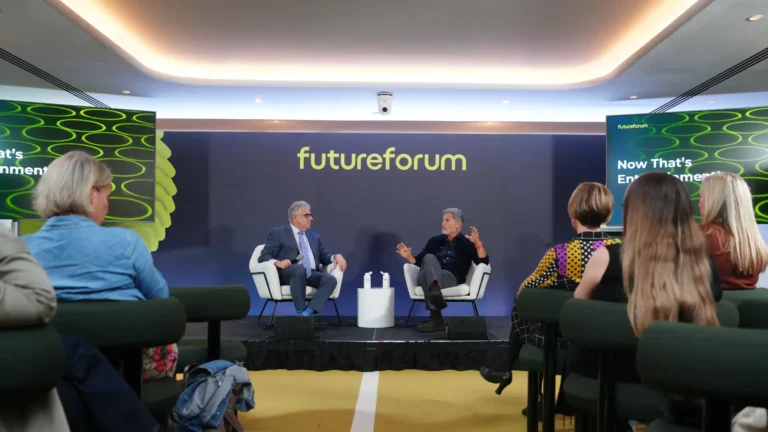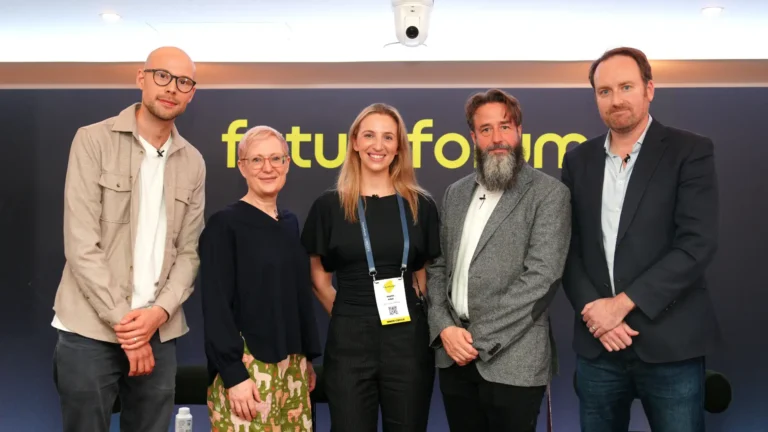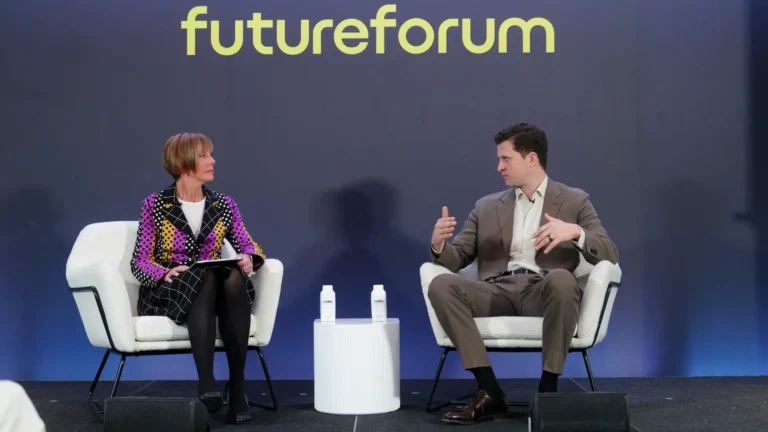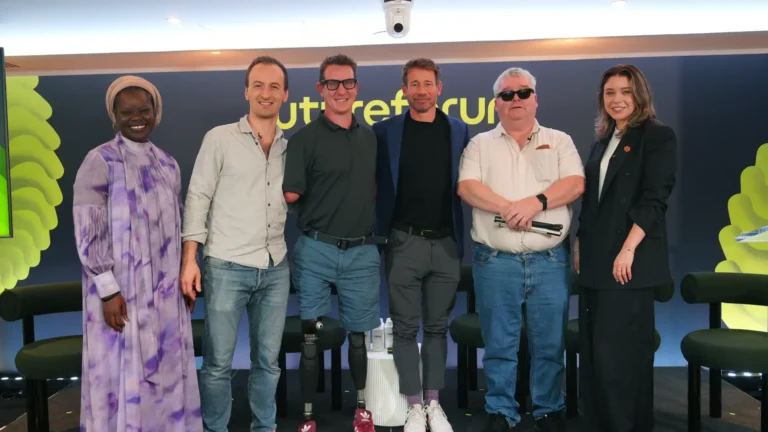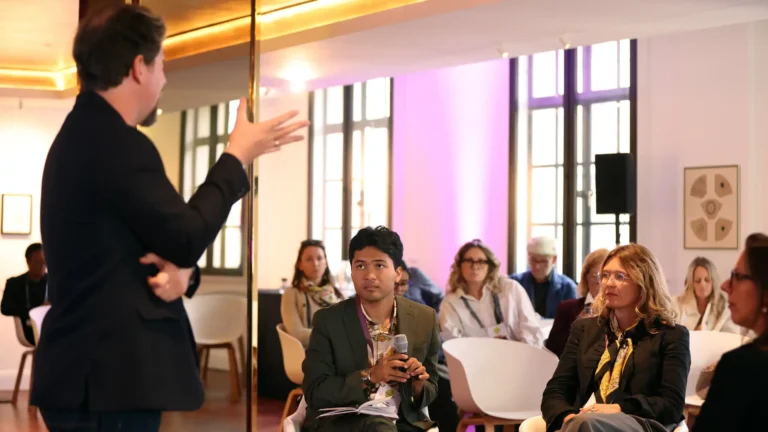
From the infrastructure we depend on to the relationships that make innovation possible, Future Forum’s closing Town Hall explored what it really takes to turn ambitious ideas into meaningful change.
We’ve spent two days imagining different futures. But what happens when it’s time to build them?
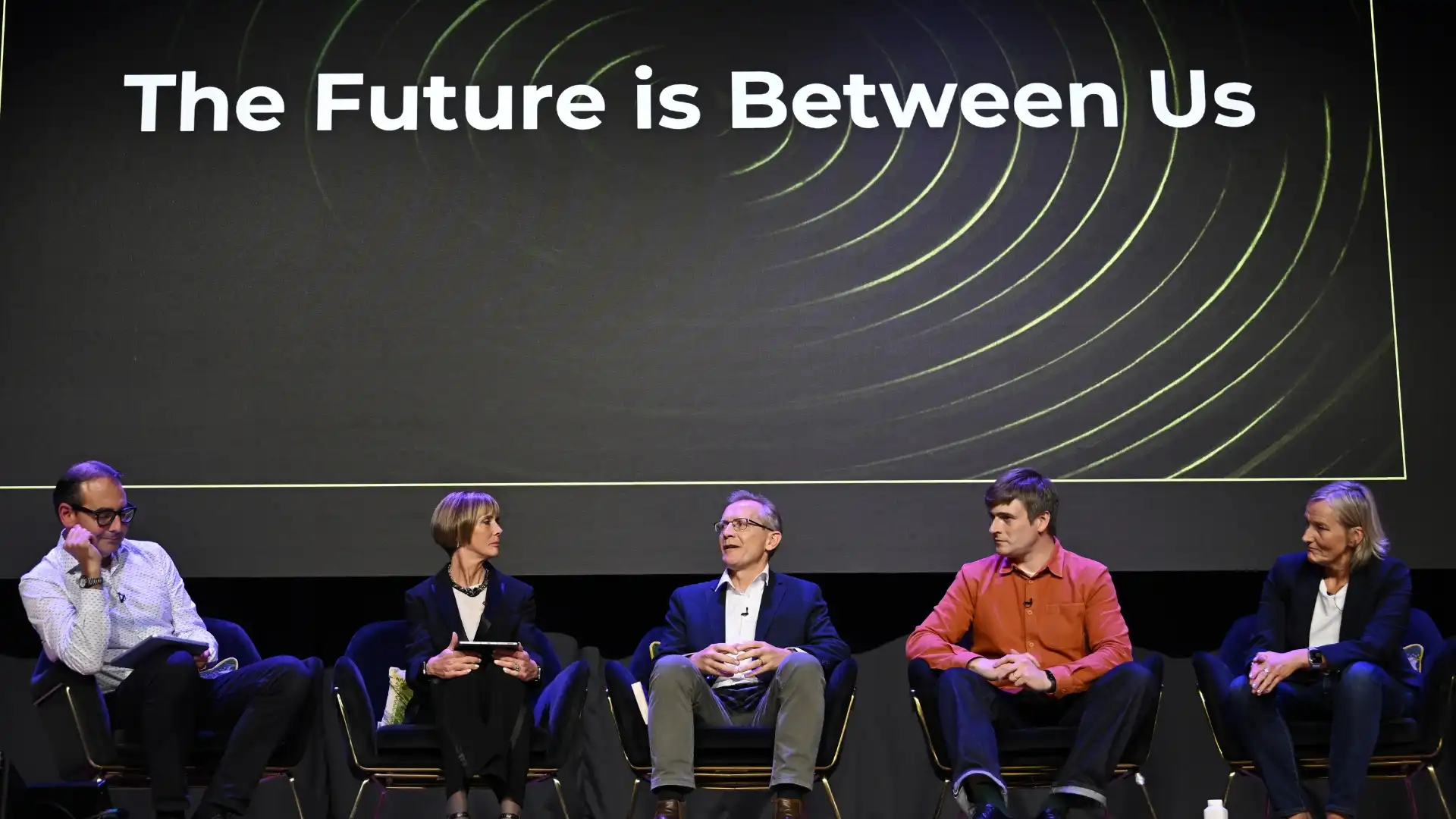
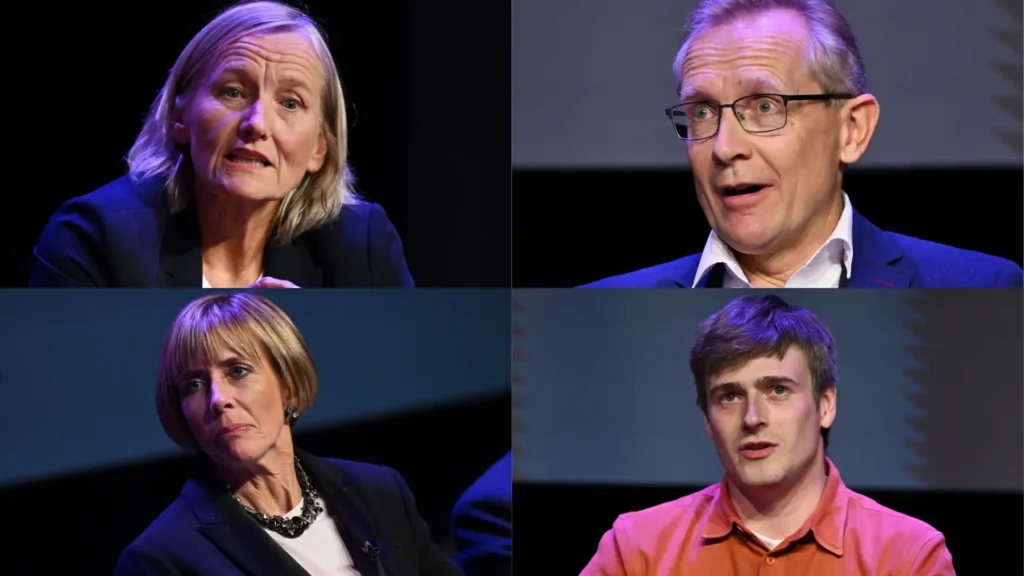
At Future Forum’s closing Town Hall, Oli Barrett MBE brought together voices from manufacturing, policy, innovation and communications to explore what stands between a good idea and real-world progress.
The discussion returned to a familiar Future Forum belief: the future is between us.
But collaboration means more than bringing people into the same room. It means finding ways to act together.
We need to remember how to build
Sam Dumitriu, Head of Policy at Britain Remade, challenged the UK’s ability to deliver the infrastructure it needs.
Many of the systems we rely on today are the result of decisions taken generations ago. Yet building new infrastructure has become increasingly complicated, slow and adversarial.
For Dumitriu, the challenge isn’t simply a shortage of good ideas. It’s getting the institutions involved to work towards shared outcomes.
When organisations operate under conflicting incentives, projects struggle to move forward.
Better alignment, he argued, could help Britain rediscover its capacity to build.Innovation needs manufacturing
Professor Tim Minshall of the University of Cambridge explored another missing connection: the gap between developing an idea and making it a reality.
It’s easy to celebrate scientific discoveries and technological breakthroughs. But innovation only creates value when those ideas can be translated into something useful.
Minshall illustrated the point through the development of an everyday object – the automatic-switch-off kettle.
Its significance wasn’t a technological breakthrough for its own sake. It came from recognising a practical problem and finding a way to solve it.
For Minshall, successful innovation starts by understanding what’s needed, rather than simply asking what technology can do.
That also requires an environment where people can experiment, take risks and learn when things don’t go to plan.
Sometimes the breakthrough is a conversation
Jaclyn Mason brought the discussion back to the power of connection.
Drawing on her experience supporting international partnerships and innovation ecosystems, she highlighted how new perspectives can change what’s possible.
Sometimes the most valuable outcome isn’t a new technology or investment.
It’s a conversation that encourages someone to think more ambitiously about what they could achieve.
The panel explored examples of entrepreneurs whose expectations changed after meeting people who challenged the scale of their ambitions.
An introduction, a question or an unexpected collaboration can become the starting point for something much bigger.
The power of constructive hope
Edie Lush offered a different perspective on progress.
Through her work interviewing leaders and thinkers, she has explored some of the most difficult questions facing humanity, from geopolitics to artificial intelligence.
But confronting those challenges doesn’t have to mean surrendering to pessimism.
Lush introduced the idea of constructive hope – not assuming everything will turn out well, but committing ourselves to the outcomes we want to create.
She also highlighted the importance of communicating difficult ideas in ways that build understanding rather than deepen fear.
Because progress depends on more than technology, policy or funding. It also depends on our ability to connect with one another.
What happens next is up to us
Across the conversation, a common challenge emerged.
We need institutions that can work together, businesses willing to invest in practical solutions, and people prepared to question assumptions and take risks.
We also need to recognise that innovation can take many forms – from advanced technology to small improvements in everyday life.
And perhaps most importantly, we need to create more opportunities for people who wouldn’t ordinarily meet to exchange ideas and work together.
As Future Forum 2026 came to a close, the message felt particularly fitting.
The future isn’t waiting somewhere ahead of us.
It’s taking shape through the decisions we make, the problems we choose to solve and the people we choose to work with.
The future is between us. What will we build together?
Related podcasts
Inside London’s Innovation Hub | Jodie Eastwood on the Future & Why Curiosity Matters
What happens when AI companies, scientists, universities, cultural institutions and local communities become neighbours? Jodie Eastwood, CEO of London’s Knowledge Quarter, believes some of the world’s biggest problems could be solved by bringing very different worlds together. In this episode of Tomorrow: The Future Forum, Jodie joins Oli Barrett MBE…

Universities Are the UK’s Innovation Engine | Vivienne Stern MBE on AI, Skills & the Future of Work
What will universities become in the age of AI? In this episode of Tomorrow: The Future Forum, Oli Barrett MBE sits down with Vivienne Stern MBE, Chief Executive of Universities UK, to explore how universities, technology and the world of work are changing and what the next decade could look…
The Future Needs Human Connection | Martina McDonnell on Marketing, Creativity & Connection
What happens to marketing when AI can translate, create and optimise at a scale we’ve never seen before? In this episode of Tomorrow, the Future Forum, Oli Barrett MBE speaks with Martina McDonnell, International Marketing Director at Meta, about the future of marketing, AI, global brands, creators, cultural relevance and…
Related speakers
-
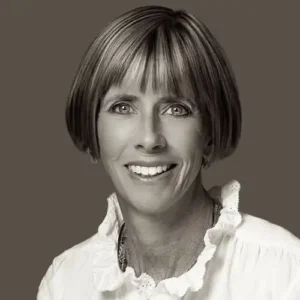
Edie Lush Co-Host of We're All Going to Die!
A journalist drawn to the point where progress becomes risk.
Edie’s profile -
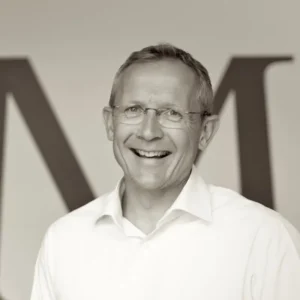
Prof. Tim Minshall Dr John C Taylor Professor of Innovation and Head of the Institute for Manufacturing of University of Cambridge
A manufacturing academic who studied the systems behind everyday life – then made them visible to everyone else.
Tim’s profile -

Sam Dumitriu Head of Policy of Britain Remade
A philosopher who applies first-principles thinking to why Britain struggles to build.
Sam’s profile