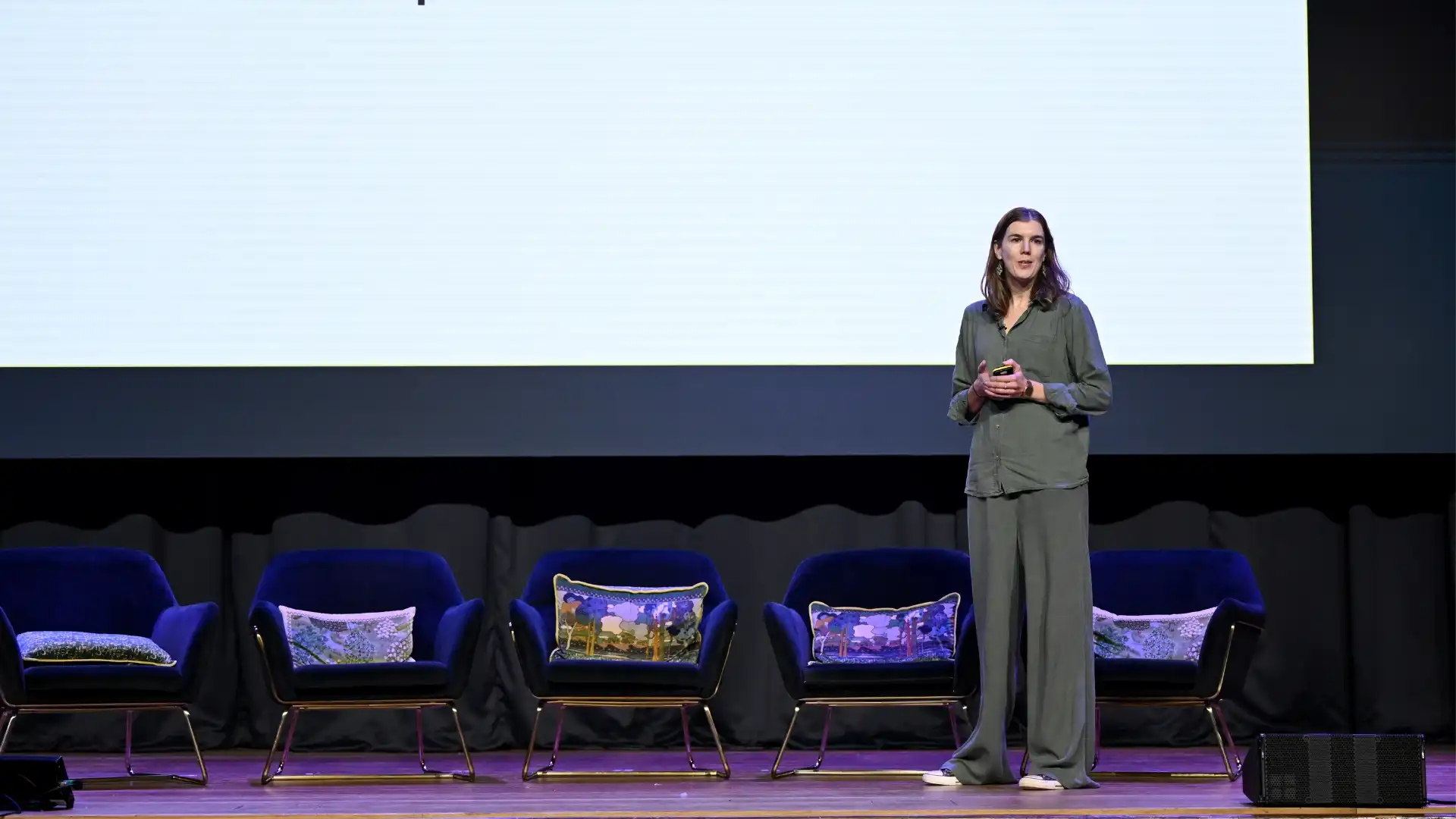
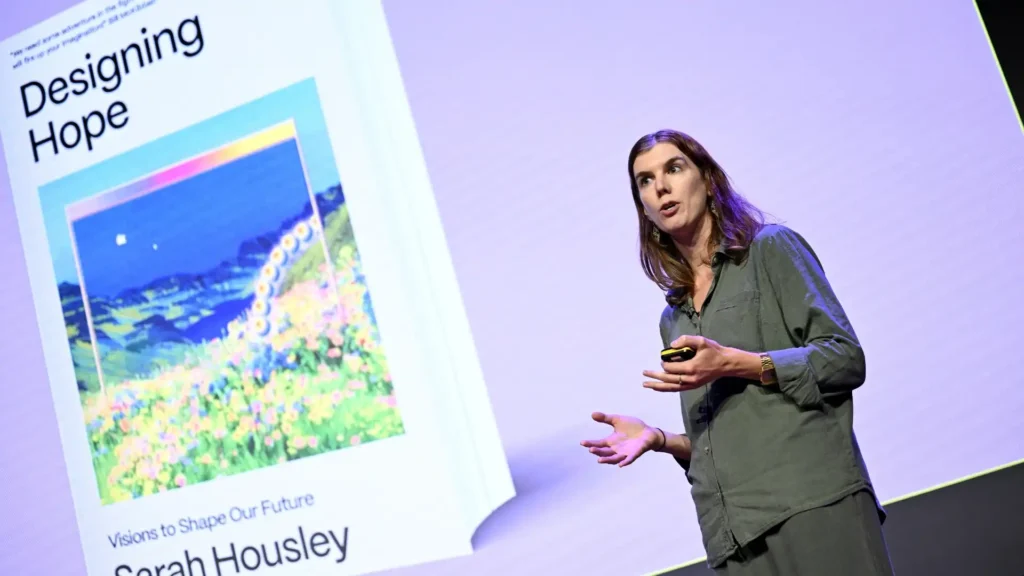
When the future feels more frightening than exciting, how do we find the confidence to shape it? At Future Forum, Sarah Housley, author of Designing Hope: Visions to Shape Our Future, explored why we need new stories about tomorrow – and how imagining more hopeful possibilities could help us make them real.
When was the last time you imagined the future and felt genuinely excited about it?
For many of us, thinking about tomorrow brings uncertainty rather than anticipation. Climate change, technological disruption and global instability can make the future feel like something to fear rather than something we can influence.
At Future Forum, Sarah Housley challenged us to think differently.
Her argument was that we’ve developed a problem with how we imagine the future. And if we can’t picture something better, how can we begin creating it?
Why the stories we tell matter
Housley pointed to the powerful relationship between our collective imagination and the world we eventually build.
The 1927 film Metropolis, for example, imagined the city of 2026 almost a century before it arrived. Its striking vision of urban life continues to influence how people think about cities and their development.
Stories like these don’t simply predict what might happen. They shape what people believe is possible.
Yet Housley argued that contemporary visions of the future often struggle to reach the wider public.
More hopeful alternatives exist, but they haven’t necessarily entered our collective imagination.
Her book, Designing Hope, seeks to change that by sharing different visions of tomorrow and inviting people to question, challenge and contribute to them.
Beyond utopia and dystopia
Too often, Housley suggested, our imagination travels in one of two directions.
There’s utopia – a perfect world that’s difficult to believe in.
And there’s dystopia – a frightening future that increasingly dominates our cultural conversations.
But there’s another possibility.
Protopia.
A protopia is neither perfect nor disastrous. It’s a future that’s messy, human and achievable – one that’s better than today, even if only incrementally.
Building on a concept introduced by Kevin Kelly, Housley encouraged the audience to think about actively designing and prototyping these more hopeful futures.
Not waiting for perfection, but exploring what meaningful progress might look like.
Making tomorrow tangible
One example Housley shared involved fictional souvenirs from a future New York City.
The project used something as simple as embroidered patches to suggest experiences and activities that might exist in a different version of the city.
Rather than presenting an abstract prediction, the objects invited people to picture themselves living in that future.
For Housley, this is where creativity becomes particularly powerful.
Stories, images and objects can make unfamiliar possibilities feel tangible, helping people imagine not just what a future looks like, but what it might feel like to experience it.
From imagination to action
Housley also challenged us to consider whose visions of the future we’re seeing.
What assumptions shape them? Whose interests do they reflect? And whose perspectives are missing?
Creating better futures requires more than choosing an appealing scenario. It means thinking about the wider systems, consequences and contradictions that come with change.
It also means giving more people the opportunity to participate in imagining what comes next.
At Future Forum, where collaboration across disciplines is at the heart of the conversation, Housley’s message offered a compelling challenge.
The future isn’t simply something we predict.
It’s something we can imagine, question, design and work towards together.
And perhaps the first step towards a brighter tomorrow is giving ourselves permission to picture one.
Related podcasts
Inside London’s Innovation Hub | Jodie Eastwood on the Future & Why Curiosity Matters
What happens when AI companies, scientists, universities, cultural institutions and local communities become neighbours? Jodie Eastwood, CEO of London’s Knowledge Quarter, believes some of the world’s biggest problems could be solved by bringing very different worlds together. In this episode of Tomorrow: The Future Forum, Jodie joins Oli Barrett MBE…

Universities Are the UK’s Innovation Engine | Vivienne Stern MBE on AI, Skills & the Future of Work
What will universities become in the age of AI? In this episode of Tomorrow: The Future Forum, Oli Barrett MBE sits down with Vivienne Stern MBE, Chief Executive of Universities UK, to explore how universities, technology and the world of work are changing and what the next decade could look…
The Future Needs Human Connection | Martina McDonnell on Marketing, Creativity & Connection
What happens to marketing when AI can translate, create and optimise at a scale we’ve never seen before? In this episode of Tomorrow, the Future Forum, Oli Barrett MBE speaks with Martina McDonnell, International Marketing Director at Meta, about the future of marketing, AI, global brands, creators, cultural relevance and…
Related speakers
-
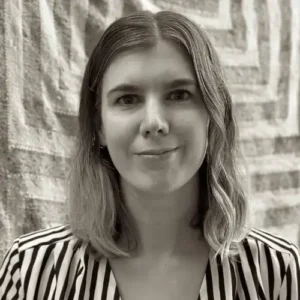
Sarah Housley Author of Designing Hope: Visions to Shape our Future
A futurist who argues that imagining better futures is part of how we build them.
Sarah’s profile